by | Jun 19, 2026 | Uncategorized
Some kids dream about secret passageways. Others dream about the moment a librarian slides the perfect book across the desk and says, Try this one. That quiet kind of magic is exactly why the best library themed kids novels matter so much. They turn shelves, stories, and reading spaces into places of adventure, comfort, and change.
For middle grade readers, library stories often offer more than cozy settings. They can hold mystery, friendship, courage, and the feeling that answers might be waiting just one shelf away. For parents, teachers, and librarians, these books are especially rewarding because they celebrate reading while also giving young readers something deeper to hold onto – hope, curiosity, and a sense of belonging.
What makes the best library themed kids novels stand out?
A strong library-centered novel does not simply place a story near bookshelves. It makes the library feel alive. Sometimes that means literal magic – secret books, unusual librarians, hidden rooms, or stories that spill into the real world. Other times, the power is quieter. A library can become a refuge for a child who feels unseen, a meeting place for unlikely friends, or the one corner of town where imagination still feels possible.
That range is part of the appeal. Some readers want fast-moving fantasy. Others want emotional realism with a thread of wonder. The best choices usually blend both. They respect young readers enough to offer real stakes, but they also leave room for delight.
12 best library themed kids novels to add to the stack
The Library of Ever by Zeno Alexander
This one is a natural fit for readers who like the idea that a library could be bigger on the inside than anyone imagined. Lenora discovers a vast library connected to worlds of knowledge, and from there the story opens into puzzles, danger, and possibility.
What makes it work is its sense of scale. The library is not just a backdrop. It is the engine of the adventure. It will appeal most to readers who enjoy imaginative world-building and big concepts, though younger or more realistic readers may need a little help settling into its fast, fantastical style.
Escape from Mr. Lemoncello’s Library by Chris Grabenstein
For kids who like games, clues, and competition, this is often the first recommendation for a reason. A group of children gets locked into a spectacular library and must solve puzzles to get out.
It is playful, energetic, and built to keep pages turning. The trade-off is that it leans more toward zany fun than emotional depth, so it may work best for readers who want a high-energy reading experience rather than a tender one.
The Forbidden Library by Django Wexler
This novel adds a darker, older-storybook feeling to the library theme. Alice enters a mysterious library filled with dangerous magic, living stories, and unsettling secrets.
There is a satisfying gothic atmosphere here, which makes it a good choice for confident middle grade readers who enjoy spooky tension without stepping fully into horror. Sensitive readers may find parts intense, but for the right child, that eerie mood is part of the charm.
Pages & Co.: Tilly and the Bookwanderers by Anna James
Tilly’s grandparents own a bookshop, but the bookish magic in this series feels deeply connected to libraries and the dream of entering stories themselves. Tilly discovers she can bookwander, traveling into the worlds of beloved characters.
This is a lovely pick for readers who already adore classics and literary references. It is gentle, imaginative, and full of affection for reading. It helps to have a child who enjoys book talk and story worlds, since some of the pleasure comes from recognizing familiar titles and characters.
The Midnight Library by Kazuno Kohara
This illustrated chapter book offers a softer, younger entry into the library theme. A little girl named Katinka opens a library at night for animals who cannot visit during the day.
For newly independent readers, this book has warmth and whimsy in equal measure. It is less of a full middle grade novel than some others on this list, but it can be a beautiful bridge for kids who are just beginning to fall in love with library stories.
The Bookwanderers by Brandon Mull
Although it centers on a larger magical system, this story taps into a fantasy many book-loving kids share – entering the worlds inside books. Characters and stories become porous, and reading becomes active, risky, and thrilling.
This is a good option for readers who like action and magical rules. It is less rooted in the emotional atmosphere of a neighborhood library, but it absolutely captures the wonder of books as portals.
The Lost Library by Rebecca Stead and Wendy Mass
Tender, mysterious, and quietly magical, this novel follows Evan as he tries to understand a little free library that appears overnight and the old fire that changed his town.
This one stands out because it balances charm with emotional intelligence. The mystery is engaging, but the real strength is its heart. Readers who prefer thoughtful stories over nonstop action may connect deeply with it.
Inkheart by Cornelia Funke
Not every library themed book takes place inside a library, but few novels honor the power of books as vividly as this one. Characters can read people and creatures out of stories, and that gift changes everything.
It is a richer, longer read than many current middle grade novels, which makes it ideal for strong readers or family read-alouds. The reward is a story that treats books as living things with real consequence.
A Library Book for Bear by Bonny Becker
This title skews younger, but it earns a place because it captures a truth every librarian and parent recognizes: sometimes a child needs the right book, not a lecture about reading. Bear resists the library until the experience opens up for him.
For younger siblings, emerging readers, or classroom sharing, this is a sweet reminder that libraries welcome reluctant readers too.
Library Lion by Michelle Knudsen
Another picture-book-leaning choice, but one that belongs in any conversation about children and libraries. A lion begins visiting the library, and his presence raises questions about rules, belonging, and what really matters.
Its brilliance is in its simplicity. This book works beautifully as a conversation starter about community, kindness, and the purpose of rules. It is especially strong for teachers and librarians building a library culture.
The Book Witch by K.L. Baxton
For readers who love the idea that books can offer shelter as well as wonder, The Book Witch belongs in this conversation. It blends magical elements with very real childhood struggles, creating a story that feels both imaginative and emotionally grounded.
That balance can be hard to find. Some bookish fantasies stay light; others become heavy when they tackle real-life pain. This novel aims for the middle path, where resilience, friendship, and self-worth grow alongside the enchantment.
Matilda by Roald Dahl
Matilda is not a library novel in the strictest sense, but libraries are essential to her becoming who she is. Her relationship with books and with the librarian who welcomes her helps shape one of the most beloved young readers in children’s literature.
For many children, this is the book that first teaches them a library can be a lifeline. It remains timeless because it never underestimates what reading can do for a child who feels overlooked.
How to choose the right library novel for a child
It depends less on age alone and more on reading temperament. A child who loves riddles and momentum may race through Escape from Mr. Lemoncello’s Library, while a reader who craves emotional depth may prefer The Lost Library or a story with stronger real-world themes. If a child is drawn to darker fantasy, The Forbidden Library may be a hit. If they want wonder without much fear, The Library of Ever or Pages & Co. may fit better.
Adults guiding a child’s reading can also think about what the child needs right now. Some books offer escape. Some offer reassurance. Some quietly tell readers that feeling different, lonely, or uncertain does not mean they are alone. Library stories are often at their best when they do all three.
Why library stories stay with readers
There is something enduring about a story set among books. A castle can feel distant. A magical school can feel selective. But a library feels possible. It is a place many children already know, or could know, and that makes the wonder feel closer.
That closeness matters. When a child reads about a hidden room, a mysterious catalog, or a book that seems to understand them, the fantasy does not feel out of reach. It feels like the sort of thing that might happen on an ordinary Tuesday, just after school, if they turn the right corner.
And maybe that is why the best library themed kids novels have such staying power. They do not just celebrate books. They celebrate the child walking through the door, wondering if there might be a story waiting with their name on it.
The right library novel can become more than a recommendation. It can become an invitation – to imagine more bravely, to read more deeply, and to believe that safe, surprising places still exist.
by | Jun 17, 2026 | Uncategorized
A child who loves dragons is not always looking for the same thing as a child who loves magic. That is where realistic fantasy vs high fantasy for kids becomes such a useful conversation. Both can enchant young readers, but they do very different emotional work.
For parents, teachers, and librarians, this distinction matters because the right kind of fantasy can help a reader feel seen, stretched, comforted, or brave. For kids themselves, it often comes down to a simple feeling: Do I want to step into a completely different world, or do I want magic to walk beside the world I already know?
What realistic fantasy vs high fantasy for kids really means
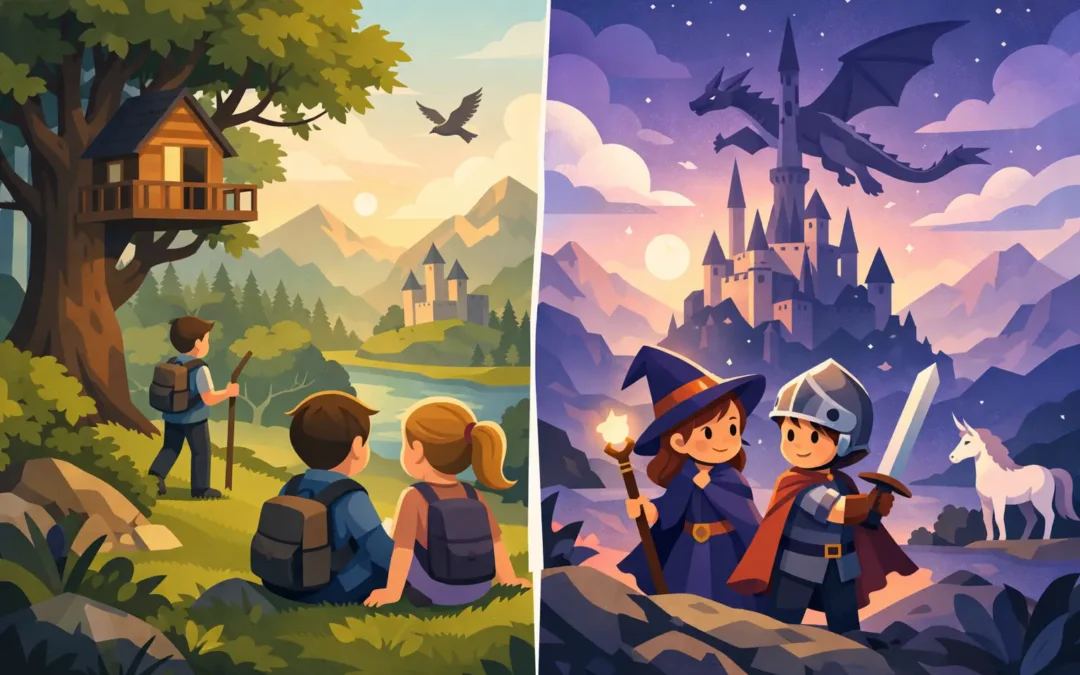
Realistic fantasy places magic inside a world that otherwise feels familiar. The setting may be a school, a neighborhood, a library, an apartment building, or a town that looks a lot like the one a child lives in. The fantasy element enters that ordinary space and changes it. A mysterious book might whisper. A hidden doorway might appear in a basement. A child who is dealing with loneliness, money worries, or family change might discover that wonder has been there all along.
High fantasy works differently. It builds a world separate from our own, with its own rules, history, geography, creatures, and often its own conflicts between good and evil. Children reading high fantasy are not just meeting magic. They are learning a new reality.
Neither approach is better. They simply offer different doorways into story.
Why the difference matters for young readers
When adults choose books for children, we sometimes focus first on reading level or popular trends. Those things matter, but emotional fit matters too. A book can be beautifully written and still miss the moment a child is in.
Realistic fantasy often feels especially powerful for readers who want adventure without losing the comfort of recognizable life. If a child is navigating friendship trouble, family instability, moving, grief, or questions about belonging, a grounded fantasy story can offer both escape and reassurance. It says, in effect, your world is hard sometimes, but it is still full of possibility.
High fantasy can offer a different kind of freedom. It gives children room to imagine beyond the limits of everyday life. Big quests, ancient prophecies, hidden kingdoms, and epic stakes can help young readers think about courage, loyalty, justice, and sacrifice from a little more distance. That distance can be a gift. Sometimes a child can face a hard truth more easily when it arrives wearing a cloak and carrying a lantern.
Realistic fantasy vs high fantasy for kids by reading experience
The biggest difference is not just setting. It is how the story feels while you read it.
Realistic fantasy feels close to home
In realistic fantasy, the emotional center is often immediate and personal. The main character may be worried about a friend, a parent, school, money, or fitting in. The magic does not erase those struggles. It usually deepens them, reveals them, or gives the character a new way to face them.
That is why these books can be so moving for middle grade readers. At this age, kids are beginning to notice the complexity of the world around them. They are old enough to feel its unfairness and young enough to hope it can still be transformed. Realistic fantasy honors both truths.
This style also tends to be more accessible for children who are newer to fantasy. Because so much of the world is familiar, the reader does not have to learn pages of backstory before getting emotionally invested.
High fantasy feels expansive and immersive
High fantasy asks more from the reader at the beginning, but it often rewards that effort with a sweeping sense of wonder. Children may need to learn unusual place names, customs, creatures, or systems of magic. For some readers, that is the whole joy of it.
Kids who love maps, lore, invented languages, royal lineages, and large-scale adventure often thrive here. These books can make a child feel gloriously small in the best way, as if the story world is stretching far beyond the edges of the page.
The trade-off is that some younger or more hesitant readers may find high fantasy harder to enter. If the worldbuilding comes before emotional connection, they might drift. That does not mean the book is wrong for them forever. It may simply mean it is not the right fit yet.
Which kind of fantasy works best for ages 8 to 12?
Middle grade readers are wonderfully varied, so there is no one answer. Still, patterns do emerge.
Readers on the younger end of the range, or those just building reading confidence, often connect quickly with realistic fantasy. Familiar settings create an easier path into the story. The child can focus on character and feeling without also decoding an entirely new world.
By contrast, many older middle grade readers are ready for the layered structure of high fantasy, especially if they already love series fiction. They may enjoy keeping track of kingdoms, rival factions, magical systems, and long-running stakes.
But maturity is not the same as age. A nine-year-old who adores elaborate fantasy worlds may be far more prepared for high fantasy than an eleven-year-old who prefers contemporary stories with just a touch of magic. Interest should lead the way.
How adults can choose the right fantasy book
A good question to ask is not, Is this book popular? It is, What kind of wonder does this child need right now?
If a reader is going through a tender season, realistic fantasy can be a beautiful companion. It keeps one foot in real life, which can make hope feel reachable. Stories in this category often open meaningful conversations because children can recognize themselves in the problems, even when the magic is impossible.
If a reader is craving adventure, scale, or total immersion, high fantasy may be the better match. These books can be especially satisfying for children who want to feel transported somewhere wholly new.
Teachers and librarians may also think about group use. Realistic fantasy often supports discussion around social-emotional themes with a little more ease, because the connections to everyday life are closer to the surface. High fantasy can be wonderful for discussions too, especially around bravery, leadership, and moral choice, but it may require more scaffolding for some readers.
Why realistic fantasy holds a special place in middle grade
There is something especially tender and true about magic appearing in ordinary childhood spaces. A hallway, a library shelf, a neglected room, a rainy street – these settings remind readers that wonder does not belong only to distant kingdoms. It can exist right where they are.
That is one reason realistic fantasy remains such a powerful form for stories about resilience, friendship, self-worth, and hope. It allows a child to see that difficult circumstances do not cancel imagination. In many of the most memorable middle grade novels, magic becomes not an escape from reality but a way of understanding it more deeply.
That balance can be especially meaningful for adults seeking books that are both imaginative and emotionally grounded. A story can hold enchantment and still make room for topics like poverty, family strain, or loneliness. In fact, when handled with care, the fantasy can help young readers approach those themes with more openness and courage.
When high fantasy is exactly the right choice
High fantasy shines when a child wants magnitude. Some readers do not want a hidden spark of magic in a familiar town. They want castles, quests, ancient enemies, and a world that feels old and alive.
These stories can nurture stamina, imagination, and a love of complex narrative. They also give children a chance to wrestle with timeless themes on a mythic scale. The battle may be against a dark ruler or a cursed force, but the heart of the story is often still about choosing kindness, loyalty, truth, or sacrifice.
For many kids, high fantasy becomes a reading milestone. It is the kind of book that makes them feel they have traveled somewhere and returned changed.
The best fantasy for kids is the one that meets them where they are
When we talk about realistic fantasy vs high fantasy for kids, we are really talking about different ways stories offer wonder. One says magic might be hidden in the life you already know. The other says there are whole worlds waiting beyond the edge of the map.
Both matter. Both can shape a reader for life.
If you are choosing for a child, pay attention to what lights them up, but also to what steadies them. Some seasons call for a faraway kingdom. Others call for a familiar street touched by the impossible. And sometimes the most meaningful book is the one that helps a young reader believe that even in an ordinary life, something extraordinary can still begin.

by | Jun 15, 2026 | Uncategorized
Some stories stay with kids because of the magic, the mystery, or the adventure. Others last because of the friend who showed up at exactly the right moment. The best books about friendship do both. They give readers a world to step into, but they also remind them that being seen, chosen, forgiven, and understood can feel every bit as powerful as a spell.
For middle grade readers, friendship stories matter in a special way. These are the years when lunch tables can feel complicated, group projects can test patience, and finding your people can seem like the biggest quest of all. A good friendship novel does not pretend that connection is always easy. It makes room for jealousy, mistakes, loneliness, and the quiet courage it takes to trust someone. Just as importantly, it offers hope.
Why books about friendship matter so much
Children often recognize themselves in friendship stories before they can explain what they are feeling out loud. A character who feels left out, misunderstood, or uncertain can help a reader name emotions that would otherwise stay tangled up inside. That is one reason these books are so valuable to parents, teachers, and librarians as well as young readers.
Friendship in fiction also gives kids a safe place to think through real social challenges. What happens when two friends want different things? What if a new friend seems exciting, but an old friend feels forgotten? What does loyalty look like when someone makes a bad choice? Stories let children consider those questions without the pressure of answering them in real time.
The strongest friendship books do not flatten these moments into simple lessons. They show that kindness and honesty can exist alongside hurt feelings. They understand that belonging is precious partly because it can be fragile.
What makes the best books about friendship stand out
Not every book with a pair of friends at its center leaves a lasting mark. The memorable ones tend to share a few qualities. First, the friendships feel specific. One child may be bold where the other is careful. One may be talkative, while the other notices everything and says less. Their bond is built from who they are, not just from the plot needing them to stand side by side.
Second, the story allows the friendship to change. That matters because real friendship changes too. Kids grow. Families move. Secrets come out. Confidence rises and falls. A believable book understands that friendship is not a fixed prize at the end of the story. It is a living relationship that has to be tended.
Third, the very best titles respect young readers. They do not treat friendship as small compared with the so-called bigger themes of courage, poverty, grief, identity, or home. Often, friendship is the way children survive those larger challenges.
12 memorable books about friendship for middle grade readers
1. Charlotte’s Web by E.B. White
This classic remains one of the gentlest and strongest portraits of friendship in children’s literature. The bond between Wilbur and Charlotte is full of tenderness, but it is not sentimental in a flimsy way. It asks what it means to care for someone when you cannot control what happens next.
For younger middle grade readers, this is often a first encounter with the idea that friendship can be both joyful and heartbreaking. That emotional honesty is part of why the book endures.
2. Bridge to Terabithia by Katherine Paterson
Some books understand how friendship can transform a child’s inner life. This is one of them. Jess and Leslie create a world together, but their friendship matters because it gives each of them room to be fully themselves.
It is best for readers ready for deeper emotion. For adults sharing books with children, this one can open meaningful conversations about imagination, grief, and the way a true friend changes how we see the world.
3. Because of Winn-Dixie by Kate DiCamillo
Not every friendship story begins with a perfect best friend. Sometimes it begins with loneliness, a little courage, and a stray dog who nudges people toward one another. This novel beautifully shows how friendship can form across ages and circumstances.
Its warmth makes it especially appealing for readers who like heartfelt stories without losing humor. The friendships here grow through listening, patience, and small acts of trust.
4. The Hundred Dresses by Eleanor Estes
This is a quieter book, but its impact is lasting. It explores friendship through absence, regret, and the consequences of standing by when someone is mistreated. That may sound heavy, yet the story remains accessible and deeply humane.
For classrooms and family discussions, it is especially useful because it moves beyond the easy question of who is mean and who is nice. It asks children to consider responsibility.
5. Ivy and Bean by Annie Barrows
Some friendship books shine because they are funny, lively, and full of personality. Ivy and Bean are delightfully different from one another, and that difference is exactly what makes their friendship sparkle. Their adventures have enough mischief to keep young readers turning pages.
This series works well for kids who want friendship stories with energy rather than emotional heaviness. It still offers something true – real friends do not have to be exactly alike.
6. Front Desk by Kelly Yang
Friendship in this novel is shaped by class, courage, and the complicated realities of family life. Mia’s world is not easy, and that is part of what makes the friendships in the book feel so meaningful. Support is never taken for granted.
This is a strong pick for readers who are ready for contemporary stories grounded in real pressures. It shows that friendship can be both comforting and brave.
7. Wonder by R.J. Palacio
At its heart, this is a story about kindness, but not the simple kind printed on a poster. It is about the choices children make when kindness costs them something socially. Friendship here is tied to empathy, loyalty, and the risk of standing apart from the crowd.
Because the novel offers multiple perspectives, readers get to see how friendship looks and feels from different angles. That makes it especially rich for discussion.
8. Out of My Mind by Sharon M. Draper
This novel gives readers a powerful reminder that friendship begins with truly seeing someone. Melody’s intelligence and humor have always been there, but many people underestimate her. The friendships that matter in this story grow from respect.
It is an important book for developing empathy, though it never feels like homework. Its emotional force comes from character, not preaching.
9. Hello, Universe by Erin Entrada Kelly
This story weaves several lives together and shows that friendship does not always arrive in obvious ways. Some children are shy, some are lonely, some are trying hard to appear stronger than they feel. The book understands how connection can begin with uncertainty.
Readers who enjoy quieter, character-driven books will find a lot to love here. The emotional payoffs are subtle but satisfying.
10. Fish in a Tree by Lynda Mullaly Hunt
School can be a hard place to hide and a harder place to belong. This novel captures both realities with great compassion. As Ally begins to feel understood, friendship becomes part of her growing confidence.
The book is especially meaningful for children who have ever felt different or underestimated. It offers reassurance without pretending that self-belief arrives overnight.
11. The One and Only Ivan by Katherine Applegate
This is a friendship story with unusual characters and a very big heart. Ivan, Stella, and Ruby teach readers that friendship includes protection, sacrifice, and speaking up when someone vulnerable needs help.
Though the setting is unusual, the emotional truth is clear. Kids who love animal stories often connect deeply with this one.
12. The Book Witch by K.L. Baxton
For readers who love stories where wonder meets real-life struggle, this novel offers friendship with emotional weight. Magic may draw children in, but the heart of the story lies in belonging, resilience, and the people who help us keep going when life feels uncertain.
That blend matters. Friendship stories often feel most powerful when they do not float above real hardship, but instead shine through it.
Choosing the right friendship book for a child
It depends on what that reader needs right now. Some children want comfort. Others want laughter. Some are ready for a book that helps them think through exclusion, grief, or bullying. A child who is newly independent as a reader may do best with a lively series and fast-moving chapters. Another may be ready for a more layered novel that leaves room for bigger questions.
This is where adults can be especially helpful. Instead of only asking what reading level fits, it helps to ask what emotional experience fits. Is this child looking for a confidence boost, a funny escape, or a story that says, very gently, you are not the only one who feels this way?
There is no single perfect pick. The right book is often the one that meets a reader at the exact moment they need it.
Friendship stories leave room for hope
One of the quiet gifts of middle grade fiction is that it takes children’s relationships seriously. It understands that a lost friend can hurt, that a new friend can change everything, and that being known by another person is a kind of magic all its own. When young readers find books that honor those truths, they do more than enjoy a good story. They begin to imagine what it might look like to be a brave, loyal, and generous friend in their own lives.
Sometimes that begins with a single character on a page, reaching out a hand.
by | Jun 13, 2026 | Uncategorized
A tween who says, “I hate reading,” is often really saying, “No one has handed me the right story yet.” That is why learning how to recommend books to tweens matters so much. At this age, a book can feel like a secret doorway, but only if it meets a reader where they are – not where adults assume they should be.
Tweens live in a curious in-between. They are growing out of early chapter books, but many are not ready for the emotional weight, romance, or cynicism that can show up in teen fiction. They want adventure, humor, mystery, magic, friendship, and high stakes. Just as often, they want stories that quietly tell them they are not alone.
How to recommend books to tweens starts with the child
The best recommendation rarely begins with reading level alone. It begins with a child who is becoming more fully themselves by the day. Some tweens want fast-moving plots and laugh-out-loud scenes. Others are looking for tender stories about family, belonging, grief, or courage. A child who loves dragons may also be the child who needs a story about self-worth. A reader who asks for something “fun” may be asking for relief after a hard school week.
That is why the first question should not be, “What grade are you in?” It should be something closer to, “What kinds of stories make you want to keep turning pages?” If the tween is not sure, ask about movies, games, hobbies, or favorite school subjects. A kid who loves puzzles may enjoy mysteries. A kid who cares deeply about fairness may connect with stories about friendship, community, or kids standing up for what matters.
Adults sometimes overfocus on what they want a child to get from a book. Growth matters, of course. So do empathy and perspective. But recommendation works better when delight comes first. Once a tween trusts that reading can be satisfying, meaningful books have a much better chance of landing.
Interest matters, but so does emotional readiness
This is where recommendation becomes more thoughtful than simply matching genre to genre. Two books may both be fantasy, yet feel entirely different in emotional temperature. One might offer playful wonder and gentle suspense. Another may carry heavier themes like neglect, displacement, bullying, or loss. Neither is automatically better. The question is whether the book fits this reader, right now.
Tweens are often ready for more complexity than adults expect, especially when a story offers hope alongside hardship. In fact, many middle grade readers are drawn to books that reflect real fears and real struggles, as long as they are written with care. Stories about poverty, family instability, identity, loneliness, and resilience can be powerful mirrors. They can also open conversations that are easier to start through fiction than face to face.
Still, timing matters. A child dealing with something difficult may find deep comfort in a book that names it. Another child may need lighter fare for a while. Recommending well means respecting both possibilities without judgment.
Pay attention to the shape of the story
When adults think about content, they often think only in terms of what topics appear. Tweens, however, respond just as strongly to how a story feels. Is it tender or intense? Cozy or urgent? Funny with a serious undercurrent, or serious with flashes of joy? That emotional shape can determine whether a book feels inviting or overwhelming.
A recommendation becomes stronger when you can describe that feeling clearly. Instead of saying, “It is about a girl who faces challenges,” try saying, “This one has magic and mystery, but it also has a lot of heart. The main character goes through hard things, and the story stays hopeful.” That kind of language helps both tweens and adults make wiser choices.
How to recommend books to tweens without turning it into homework
Nothing cools a reader’s interest faster than making a recommendation sound like an assignment. Tweens are old enough to sense when a book is being offered as medicine in disguise. If your pitch sounds too worthy, they may never open the cover.
A stronger approach is to lead with the hook. Give them the question, the image, or the tension that makes the story feel alive. Mention the cursed library, the missing friend, the competition, the talking cat, the strange new neighbor, the impossible secret. Then, if it fits, you can add the emotional layer. The book does not need to hide its depth, but it should be allowed to sparkle first.
This is especially true for children who have not yet found reading confidence. They need momentum. They need story energy. They need a reason to believe that reading is not just good for them, but actually good.
Offer a few paths, not a single perfect choice
Many adults feel pressure to get the recommendation exactly right. In practice, tweens often respond better when given a small menu. Present two or three books with different flavors. One might be funny and fast. Another might be magical and heartfelt. A third might be realistic and emotionally rich. Choice gives a tween ownership, and ownership builds buy-in.
It also lowers the stakes. If a child feels they can reject one option and still be seen as a reader, they are more likely to keep trying. Recommendation should feel like invitation, not evaluation.
Use mirrors, windows, and a little surprise
Tweens need books that reflect their own experiences, but not only those books. A healthy reading life includes mirrors that affirm, windows that expand understanding, and the occasional surprise that introduces a child to a story they never would have chosen alone.
That balance matters. A reader who has moved often may feel deeply understood by a story about instability and starting over. That same reader may also need pure fantasy, humor, or historical adventure. Children are not only their hardest moments. They are also their curiosity, imagination, silliness, and hope.
This is one reason middle grade fiction can be so powerful. At its best, it honors the emotional reality of childhood while leaving room for wonder. Books that blend imaginative settings with grounded social themes often stay with readers because they tell the truth and offer possibility at the same time.
Trust the tween, but stay nearby
Adults are still important guides, especially with readers between eight and twelve. Tweens want independence, but they usually still benefit from thoughtful curation. The goal is not to control every choice. It is to notice patterns, offer options, and stay available.
If a book does not work, that does not mean the child failed or that reading is the problem. It may simply be the wrong match in pacing, voice, theme, or maturity. This is where a calm response can preserve a reader’s confidence. You can say, “That one did not click. Let us try something different.” Sometimes one disappointing book can be shrugged off. Sometimes it can convince a hesitant reader that books are boring. The adult response makes a real difference.
Look beyond age labels
Age ranges help, but they are not the whole story. One ten-year-old may devour layered novels with complex emotional arcs. Another may prefer shorter books with strong pacing and clear stakes. Both are valid readers. Recommending well means seeing the child in front of you, not chasing an idealized version of what they should be reading by now.
This also applies to kids who read above grade level. Advanced vocabulary does not always mean advanced emotional readiness. A tween may be able to decode older books and still not enjoy the worldview or content often aimed at teens. Strong recommendations protect that middle space where readers can be challenged without being pushed too far, too fast.
What adults can say when recommending a book
The words matter more than many people realize. A tween is listening for permission, excitement, and respect. Instead of saying, “You should read this because it is good for you,” try, “I think this might be your kind of story.” Instead of, “This teaches an important lesson,” try, “The main character feels real, and I kept rooting for her.” Instead of overselling with, “You will love it,” try, “You might connect with this one because it has mystery, heart, and a brave kid at the center.”
That gentler approach leaves room for personal taste. It tells the reader their response matters.
And when a book truly does combine wonder with emotional truth, it can become more than a recommendation. It can become a companion. Stories like that remind tweens that courage does not always look loud, that belonging can be built, and that hope is not childish at all. If you are choosing with care, listening closely, and leading with the magic of the story, you are already giving a young reader something valuable – the feeling that books might hold a place for them, too.

by | Jun 11, 2026 | Uncategorized
A child falls in love with a book for all kinds of reasons – a mysterious library, a brave friend, a touch of magic, a character who feels a little like them. The most memorable middle grade fiction trends are not just about what is selling. They show what young readers are hungry for emotionally, and what the grown-ups in their lives hope books can offer.
That matters because middle grade sits in a special place. These are the years when reading can become part of a child’s identity. A book can be comfort, escape, laughter, courage, or the first time a reader realizes that someone else understands what life feels like from the inside.
What middle grade fiction trends reveal right now
If there is one clear pattern in middle grade fiction trends, it is this: readers want stories with heart. Big concepts still matter. So do pace, humor, and adventure. But the books that linger tend to pair imaginative storytelling with emotional truth.
For parents, teachers, and librarians, this is encouraging. Children do not need fiction that lectures them. They need stories that trust them. The strongest middle grade novels make room for real worries – friendship trouble, family stress, money problems, loneliness, self-doubt – without taking away hope. That balance is not easy, which is why it stands out when a book gets it right.
For writers and book curators, the takeaway is simple but not simplistic. Trend awareness helps, but chasing trends too literally can flatten a story. Kids can tell when a book feels alive and when it feels manufactured.
Magic is staying, but it is getting more personal
Fantasy has always had a home in middle grade, and that has not changed. What has shifted is the kind of magic readers are gravitating toward. Instead of fantasy that only dazzles at the worldbuilding level, many current books use magic to deepen questions of identity, belonging, grief, courage, and home.
In other words, enchantment works best when it means something.
A magical object, hidden power, unusual town, or mysterious bookshop still pulls readers in. But now those elements often connect to a very human struggle. The fantasy is not only there to entertain. It gives shape to feelings children may not yet have the words to explain.
That blend is especially powerful in middle grade because it honors both sides of childhood. Kids are imaginative and practical. They can believe in wonder while also worrying about rent, family conflict, changing friendships, or whether they fit anywhere at all.
Emotional realism is no longer a niche
One of the strongest trends in the category is the rise of stories that address serious life circumstances in age-appropriate ways. Middle grade readers are encountering books about housing insecurity, divorce, bullying, anxiety, grief, disability, and social change with more openness than some adults expect.
That does not mean every child wants a heavy book. Far from it. Joy, comedy, mystery, and adventure remain essential. But there is growing respect for stories that tell the truth gently.
The key difference is tone. A middle grade novel can deal with hardship without becoming bleak. It can name pain without dwelling in hopelessness. It can leave room for resilience, friendship, and humor. That hopeful realism is one reason books with grounded emotional stakes continue to find devoted readers.
For the adults choosing books, this trend offers another benefit. Stories with emotional depth often create natural openings for conversation. A child may not want to talk directly about embarrassment, instability, or fear. They may talk very freely about a character who feels those things.
Friendship has become more layered
Friendship has always been central to middle grade, but recent books are treating it with more nuance. Instead of simple best-friend dynamics, many novels now explore shifting loyalties, social pressure, misunderstandings, jealousy, forgiveness, and the effort it takes to build trust.
That reflects real life. For readers ages 8 to 12, friendship can feel magical one day and painfully confusing the next. Books that capture that emotional weather feel deeply validating.
There is also more room now for unlikely friendships and multigenerational bonds. Kids connect with stories where support comes from surprising places – a new classmate, a sibling, a neighbor, a teacher, a librarian, or an elder who sees something special in them. These relationships widen the emotional landscape of a story and remind readers that belonging can be built, not just found.
Books about books still have a special spark
Some trends come and go quickly. Stories centered on books, reading, libraries, and literary mystery have remarkable staying power in middle grade. There is something irresistible about a child discovering that stories themselves hold power.
Part of that appeal is obvious. Book-loving kids enjoy seeing their own passions reflected back. But even reluctant readers can be drawn in by the idea that a library might hide secrets, that words might change a life, or that a quiet child might find strength through stories.
These novels often work on two levels at once. They celebrate imagination, while also reassuring readers that books are not just school tools. They are companions. Shelters. Clues. Portals. Sometimes they are the place where a child first recognizes their own worth.
For a brand like K.L. Baxton, which lives at the crossroads of wonder and emotional truth, this trend feels especially resonant.
Contemporary settings are getting richer, not smaller
Not every middle grade reader wants a dragon, a spell, or a portal. Contemporary fiction remains a strong force, and it is growing in complexity. The newest wave of realistic middle grade often focuses on ordinary settings that carry extraordinary emotional weight – apartment buildings, schools, neighborhoods, community centers, family businesses.
These books remind readers that a child’s daily world is already full of stakes. A move can feel epic. A friendship fallout can feel world-shaking. A financial strain at home can reshape how a child sees everything.
What makes this trend compelling is that realism no longer has to mean small. Contemporary middle grade can be funny, suspenseful, lyrical, and deeply moving. It can carry just as much momentum as fantasy when the emotional engine is strong.
Readers want representation that feels lived in
Another important shift is the expectation of authenticity. Children want to see a wider range of families, communities, cultures, and life experiences on the page. Adults who recommend books want that too. But readers are increasingly drawn to representation that feels woven into the fabric of the story rather than added for appearance.
That means characters are not memorable just because they check a box. They matter because they are vivid, specific, flawed, and fully human. The strongest books let identity shape the story naturally, alongside plot, voice, and relationships.
This is one area where trend talk can get shallow fast. Diversity is not a fad. It is part of telling the truth about the world children live in. The real trend is that the market is slowly getting better at recognizing stories that should have been centered all along.
Shorter attention spans have changed pacing, but not standards
It is tempting to say that today’s middle grade readers only want fast books. That is partly true. Strong hooks, clear stakes, and forward motion matter more than ever. But quick pacing does not mean thin storytelling.
Children will absolutely stay with a book that asks more of them if the voice is engaging and the emotional promise is strong. The challenge for writers is not to simplify everything. It is to create momentum without losing texture.
This is why many successful middle grade novels open with immediate intrigue, then build emotional depth chapter by chapter. They respect the reader’s time while also respecting the reader’s intelligence.
So what should parents, teachers, and librarians watch for?
The best current books tend to offer a mix of wonder and recognition. They entertain, yes, but they also help children name feelings, imagine possibilities, and practice empathy. That can happen in fantasy, mystery, realistic fiction, or stories that blend several modes at once.
When choosing for a particular child, trend awareness should always come second to reader fit. Some kids want high adventure. Some want cozy magic. Some want realism that makes them feel less alone. Some are ready for heavier themes, and some need more lightness right now. It depends on the child, the season, and sometimes even the week.
That is part of what makes middle grade so exciting. It is not one thing. It is a wide, generous space where wonder can sit beside hardship, and where hope does not have to be loud to be powerful.
The books that last are usually the ones that remember this. They do not talk down to children. They do not mistake darkness for depth or sparkle for substance. They offer adventure with feeling, honesty with gentleness, and characters who keep reaching toward light.
For young readers standing on the edge of who they are becoming, that kind of story is never just a trend. It is a hand reaching back from the page.