A child who loves dragons is not always looking for the same thing as a child who loves magic. That is where realistic fantasy vs high fantasy for kids becomes such a useful conversation. Both can enchant young readers, but they do very different emotional work.
For parents, teachers, and librarians, this distinction matters because the right kind of fantasy can help a reader feel seen, stretched, comforted, or brave. For kids themselves, it often comes down to a simple feeling: Do I want to step into a completely different world, or do I want magic to walk beside the world I already know?
What realistic fantasy vs high fantasy for kids really means
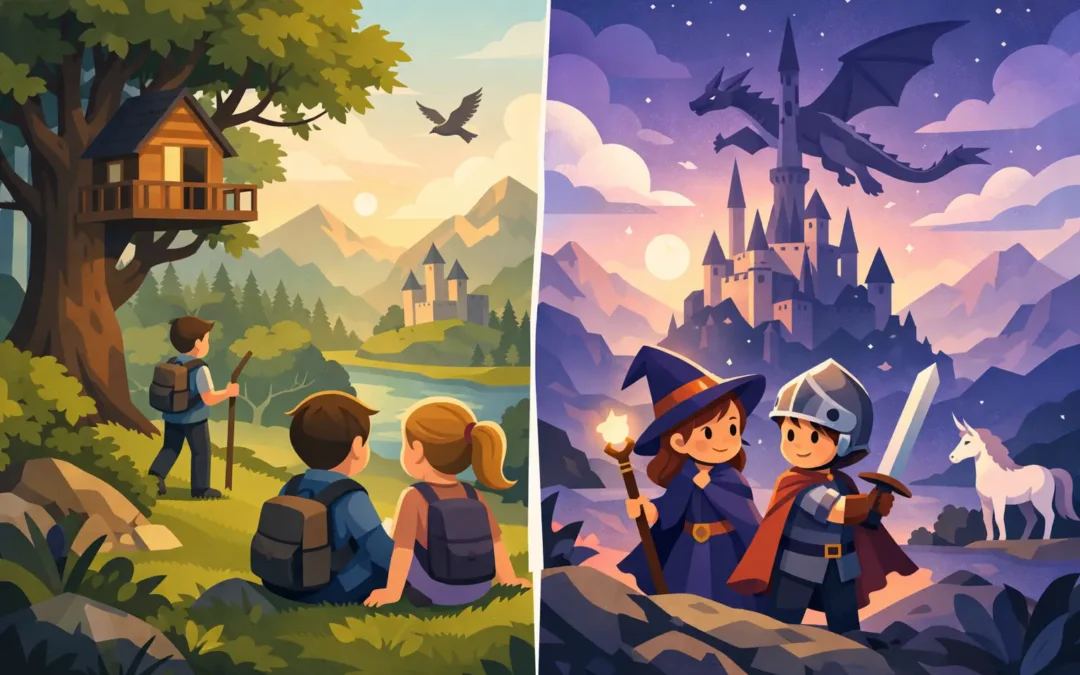
Realistic fantasy places magic inside a world that otherwise feels familiar. The setting may be a school, a neighborhood, a library, an apartment building, or a town that looks a lot like the one a child lives in. The fantasy element enters that ordinary space and changes it. A mysterious book might whisper. A hidden doorway might appear in a basement. A child who is dealing with loneliness, money worries, or family change might discover that wonder has been there all along.
High fantasy works differently. It builds a world separate from our own, with its own rules, history, geography, creatures, and often its own conflicts between good and evil. Children reading high fantasy are not just meeting magic. They are learning a new reality.
Neither approach is better. They simply offer different doorways into story.
Why the difference matters for young readers
When adults choose books for children, we sometimes focus first on reading level or popular trends. Those things matter, but emotional fit matters too. A book can be beautifully written and still miss the moment a child is in.
Realistic fantasy often feels especially powerful for readers who want adventure without losing the comfort of recognizable life. If a child is navigating friendship trouble, family instability, moving, grief, or questions about belonging, a grounded fantasy story can offer both escape and reassurance. It says, in effect, your world is hard sometimes, but it is still full of possibility.
High fantasy can offer a different kind of freedom. It gives children room to imagine beyond the limits of everyday life. Big quests, ancient prophecies, hidden kingdoms, and epic stakes can help young readers think about courage, loyalty, justice, and sacrifice from a little more distance. That distance can be a gift. Sometimes a child can face a hard truth more easily when it arrives wearing a cloak and carrying a lantern.
Realistic fantasy vs high fantasy for kids by reading experience
The biggest difference is not just setting. It is how the story feels while you read it.
Realistic fantasy feels close to home
In realistic fantasy, the emotional center is often immediate and personal. The main character may be worried about a friend, a parent, school, money, or fitting in. The magic does not erase those struggles. It usually deepens them, reveals them, or gives the character a new way to face them.
That is why these books can be so moving for middle grade readers. At this age, kids are beginning to notice the complexity of the world around them. They are old enough to feel its unfairness and young enough to hope it can still be transformed. Realistic fantasy honors both truths.
This style also tends to be more accessible for children who are newer to fantasy. Because so much of the world is familiar, the reader does not have to learn pages of backstory before getting emotionally invested.
High fantasy feels expansive and immersive
High fantasy asks more from the reader at the beginning, but it often rewards that effort with a sweeping sense of wonder. Children may need to learn unusual place names, customs, creatures, or systems of magic. For some readers, that is the whole joy of it.
Kids who love maps, lore, invented languages, royal lineages, and large-scale adventure often thrive here. These books can make a child feel gloriously small in the best way, as if the story world is stretching far beyond the edges of the page.
The trade-off is that some younger or more hesitant readers may find high fantasy harder to enter. If the worldbuilding comes before emotional connection, they might drift. That does not mean the book is wrong for them forever. It may simply mean it is not the right fit yet.
Which kind of fantasy works best for ages 8 to 12?
Middle grade readers are wonderfully varied, so there is no one answer. Still, patterns do emerge.
Readers on the younger end of the range, or those just building reading confidence, often connect quickly with realistic fantasy. Familiar settings create an easier path into the story. The child can focus on character and feeling without also decoding an entirely new world.
By contrast, many older middle grade readers are ready for the layered structure of high fantasy, especially if they already love series fiction. They may enjoy keeping track of kingdoms, rival factions, magical systems, and long-running stakes.
But maturity is not the same as age. A nine-year-old who adores elaborate fantasy worlds may be far more prepared for high fantasy than an eleven-year-old who prefers contemporary stories with just a touch of magic. Interest should lead the way.
How adults can choose the right fantasy book
A good question to ask is not, Is this book popular? It is, What kind of wonder does this child need right now?
If a reader is going through a tender season, realistic fantasy can be a beautiful companion. It keeps one foot in real life, which can make hope feel reachable. Stories in this category often open meaningful conversations because children can recognize themselves in the problems, even when the magic is impossible.
If a reader is craving adventure, scale, or total immersion, high fantasy may be the better match. These books can be especially satisfying for children who want to feel transported somewhere wholly new.
Teachers and librarians may also think about group use. Realistic fantasy often supports discussion around social-emotional themes with a little more ease, because the connections to everyday life are closer to the surface. High fantasy can be wonderful for discussions too, especially around bravery, leadership, and moral choice, but it may require more scaffolding for some readers.
Why realistic fantasy holds a special place in middle grade
There is something especially tender and true about magic appearing in ordinary childhood spaces. A hallway, a library shelf, a neglected room, a rainy street – these settings remind readers that wonder does not belong only to distant kingdoms. It can exist right where they are.
That is one reason realistic fantasy remains such a powerful form for stories about resilience, friendship, self-worth, and hope. It allows a child to see that difficult circumstances do not cancel imagination. In many of the most memorable middle grade novels, magic becomes not an escape from reality but a way of understanding it more deeply.
That balance can be especially meaningful for adults seeking books that are both imaginative and emotionally grounded. A story can hold enchantment and still make room for topics like poverty, family strain, or loneliness. In fact, when handled with care, the fantasy can help young readers approach those themes with more openness and courage.
When high fantasy is exactly the right choice
High fantasy shines when a child wants magnitude. Some readers do not want a hidden spark of magic in a familiar town. They want castles, quests, ancient enemies, and a world that feels old and alive.
These stories can nurture stamina, imagination, and a love of complex narrative. They also give children a chance to wrestle with timeless themes on a mythic scale. The battle may be against a dark ruler or a cursed force, but the heart of the story is often still about choosing kindness, loyalty, truth, or sacrifice.
For many kids, high fantasy becomes a reading milestone. It is the kind of book that makes them feel they have traveled somewhere and returned changed.
The best fantasy for kids is the one that meets them where they are
When we talk about realistic fantasy vs high fantasy for kids, we are really talking about different ways stories offer wonder. One says magic might be hidden in the life you already know. The other says there are whole worlds waiting beyond the edge of the map.
Both matter. Both can shape a reader for life.
If you are choosing for a child, pay attention to what lights them up, but also to what steadies them. Some seasons call for a faraway kingdom. Others call for a familiar street touched by the impossible. And sometimes the most meaningful book is the one that helps a young reader believe that even in an ordinary life, something extraordinary can still begin.