
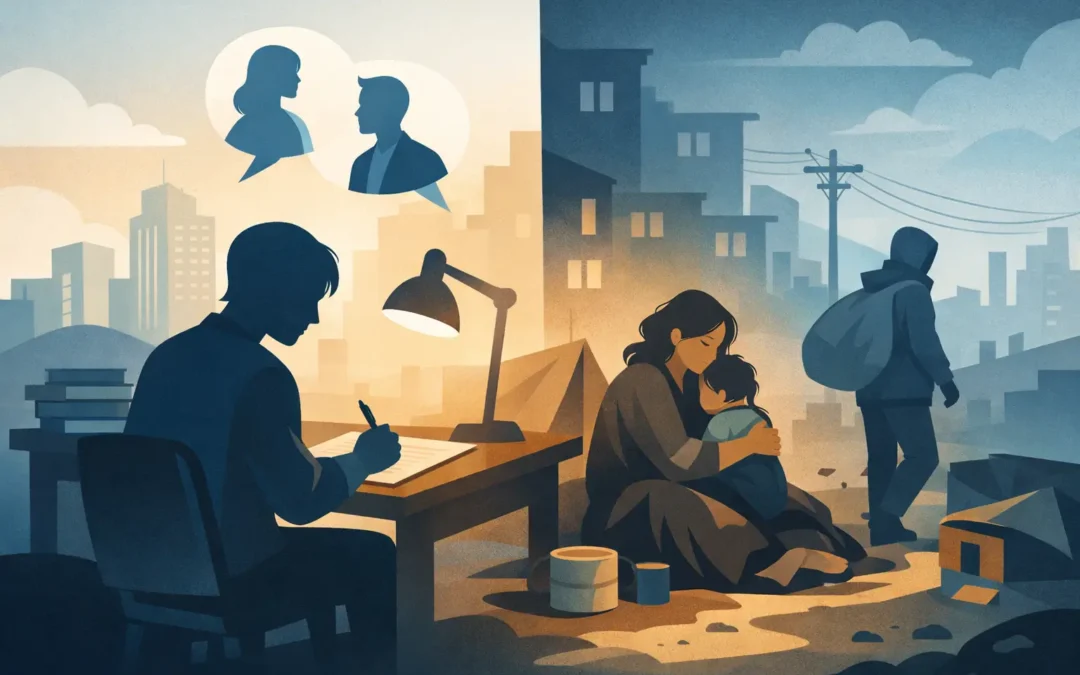
A child notices what grown-ups miss. The backpack that never quite zips. The friend who says they already ate. The library book returned late because home was too complicated to keep track of due dates. If you’re wondering how to discuss poverty in fiction, that is a good place to begin – not with a lesson, but with the small, human moments that reveal a life.
For writers, teachers, parents, and librarians, this subject asks for more than good intentions. Poverty is not a character trait. It is not a shortcut to make a story feel serious. And it is not one-size-fits-all. When fiction handles it with care, young readers feel seen, empathy grows naturally, and the story keeps its heart. When it is handled poorly, characters flatten into symbols, and readers can feel the distance.
How to Discuss Poverty in Fiction Without Flattening a Character
The first rule is simple – start with personhood. A child experiencing poverty is still funny, stubborn, creative, jealous, hopeful, bookish, messy, brave, and scared in their own particular way. Financial hardship shapes daily life, but it does not erase individuality. Readers connect to a whole child, not to an issue wearing a name tag.
That means a character’s wants should matter just as much as their struggles. Maybe they want to win the school art contest, keep a promise to a sibling, or protect a secret place that feels safe. Poverty may complicate those goals, but it should not be the only thing happening on the page. The strongest middle grade stories often hold both truths at once – life can be hard, and life can still contain wonder.
This is especially important for young readers. Children do not need every hardship softened, but they do need stories that leave room for dignity. A character can need help without becoming helpless. They can feel embarrassed without being defined by shame. They can be vulnerable and still make meaningful choices.
Show the texture of poverty, not just the label
In fiction, the word poor tells us very little on its own. The lived experience is what matters. Does a family move often because rent keeps changing? Does a child hide a permission slip because they know there is no money for the field trip? Does a parent work nights, leaving an older sibling to patch together dinner and homework routines?
Specific details create truth. They also create variety, because poverty does not look the same in every home, neighborhood, or region. One child may live in a crowded apartment with loving relatives. Another may live in a motel. Another may have a stable home but constant stress over bills, food, transportation, or medical needs. The material realities are different, and so are the emotional ones.
Writers sometimes lean too hard on visual shorthand – torn clothes, empty cupboards, dramatic misery in every scene. Those details can exist, of course, but overusing them can make the portrayal feel staged. Often, the more revealing details are quieter. A child who memorizes which classmates get extra snacks. A parent who is always doing complicated math in the grocery aisle. A kid who becomes an expert at making excuses.
Avoid turning poverty into a moral test
One of the oldest mistakes in storytelling is treating poverty as proof of virtue or failure. The saintly poor child and the irresponsible poor family are two versions of the same problem – both are stereotypes.
Real families are complicated. Some adults make wise choices under pressure. Some make harmful ones. Many are doing both at different times because stress changes people. Systems matter too. Low wages, housing instability, school inequity, disability, immigration status, and gaps in community support all affect what a family can do. Fiction does not need to become a policy paper, but it should leave room for the truth that poverty is bigger than personal merit.
For middle grade readers, this nuance matters. Children are already forming ideas about fairness, responsibility, and belonging. A story can help them think more deeply by showing pressure instead of passing instant judgment. It can ask, in effect, What would this feel like? What choices would narrow? What courage would still remain?
How to discuss poverty in fiction for middle grade readers
Writing for ages 8 to 12 brings a special responsibility. Young readers are capable of emotional depth, but they also need clarity, movement, and hope. That does not mean every story needs a neat ending where money problems vanish. It does mean the emotional experience should not trap the reader in despair.
A good middle grade novel often filters hardship through what a child can see, misunderstand, or slowly piece together. Adults may talk in fragments. A child may notice overdue notices before they understand debt. They may know the lights went out once, but not the full story behind it. That perspective is powerful because it feels true to childhood. It also protects the story from sounding like an adult lecture dropped into a child’s world.
Tone matters here. Humor, friendship, imagination, and small victories are not distractions from serious themes. They are part of how children survive them. A magical story, for example, can hold a very real struggle without minimizing it. Wonder and realism can strengthen each other when both are grounded in emotional honesty.
Let community exist on the page
Stories about hardship sometimes isolate characters too completely, as if suffering happens in a vacuum. But children live in webs of relationship. Friends notice. Teachers misread signals or step up in quiet ways. Librarians, neighbors, siblings, bus drivers, coaches, and grandparents can all shape how a child experiences need.
Community in fiction should not become a parade of saviors. That can be just as flattening as neglect. Still, it is worth showing that support can come from ordinary human care – a borrowed book, a ride home, a patient adult, a friend who shares without making a spectacle of generosity. These gestures do not solve structural problems, but they can change what a day feels like.
For readers, this matters because it invites empathy without pity. Pity looks down. Empathy looks across. The difference is everything.
Research, listen, and check your blind spots
If you have not experienced poverty yourself, extra humility helps. Research should go beyond statistics. Memoirs, interviews, classroom observations, local context, and conversations with sensitivity readers can all deepen your understanding. Even if you have lived experience, your experience is still only one version.
Ask hard questions as you draft. Am I making this character admirable only when they endure quietly? Am I giving them agency? Have I confused scarcity with lack of intelligence, culture, or love? Am I relying on dramatic scenes while skipping the daily problem-solving that shapes real life?
This is also where language matters. Characters may describe themselves in different ways depending on age, family, and setting. The narration should avoid loaded phrasing that turns people into categories before readers know them as people. Gentle precision usually serves the story best.
Keep an eye on what the story rewards
Every novel teaches something, even when it does not mean to. Look at what your story celebrates. Does the child only become worthy of care after being exceptionally talented, cheerful, or resilient? Does help arrive only if they stay grateful and undemanding? Those patterns can quietly send the wrong message.
Sometimes the most honest choice is to let a character be angry, awkward, or wrong without losing the reader’s compassion. Children under pressure are still children. They may lash out. They may lie. They may guard their pride fiercely. If fiction makes room for those messy truths, it becomes more believable and more humane.
At the same time, readers need a reason to keep turning pages. Hope can come from many places – friendship, courage, imagination, a truthful conversation, a door opening just a little. Hope does not have to mean rescue. Often it simply means the story refuses to look away from a child’s worth.
That is one reason books with emotional realism stay with readers for so long. They offer recognition, but they also offer light. In work like K.L. Baxton’s, where wonder sits beside real hardship, the story can remind children that difficult circumstances do not cancel magic, dignity, or possibility.
If you are writing or choosing books on this theme, trust young readers with the truth, but give them more than pain to hold. Give them a character with spark. Give them specific, lived-in details. Give them relationships that feel real. Most of all, give them a story that remembers this simple fact – a child is never an issue first, and fiction is at its best when it never forgets it.