
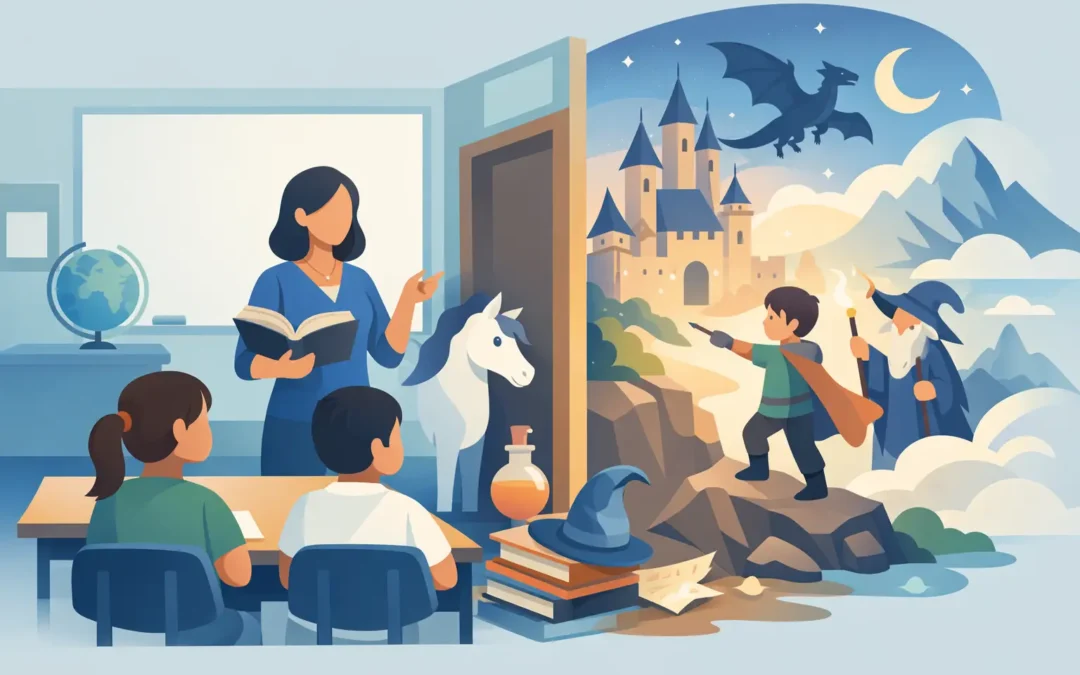
A child who hesitates to talk about money problems, grief, loneliness, or feeling out of place will often talk about a cursed forest, a hidden key, or a girl who hears whispers from books. That is one reason teachers keep returning to imaginative stories. If you are wondering how to use fantasy in classrooms, the short answer is this: use it not as an escape from real life, but as a gentle, powerful way into it.
Fantasy gives students enough distance to be honest. A dragon, a spell, or a secret library can lower the stakes just enough for readers to ask hard questions. Who gets left out? What makes someone brave? What do we owe one another when life feels unfair? For upper elementary and middle grade students especially, that distance matters. It protects their tenderness while still inviting deep thinking.
Why fantasy belongs in real learning
Some adults still treat fantasy as extra credit for the imagination, pleasant but less serious than realistic fiction. In the classroom, that view misses what fantasy does so well. It helps students practice interpretation, infer rules, track cause and effect, and recognize symbolism. Those are core literacy skills, not decorative ones.
Just as importantly, fantasy helps children name emotional truths they may not have words for yet. A character carrying an invisible burden, entering a dangerous world, or discovering unexpected power often mirrors what young readers feel in ordinary life. Friendship struggles, family stress, social pressure, and questions of identity can all appear in magical form without losing their weight.
That is why fantasy works best when it is taught with respect. Students know the difference between a fun story and a meaningful one. When a teacher treats the genre as thoughtful literature, students usually rise to meet that expectation.
How to use fantasy in classrooms without losing focus
The strongest fantasy lessons start with intention. Before opening the book, it helps to ask what kind of thinking you want students to do. Are you focusing on theme, character growth, worldbuilding, symbolism, or discussion of real-world issues through story? Fantasy can support all of these, but not all at once.
For example, if your goal is close reading, choose a scene where the magical details reveal character or conflict. If your goal is social-emotional learning, choose a text where the fantasy elements reflect belonging, fear, courage, or resilience. If your goal is writing, use fantasy to help students imagine alternate worlds with rules, stakes, and consequences.
The mistake is not using fantasy. The mistake is using it only for decoration. A classroom dragon should not just roar. It should mean something.
Start with the human problem
Students connect most deeply to fantasy when they can identify the real feeling beneath the magic. A child in a magical story may be searching for a lost object, but underneath that quest might be grief, instability, or the need to be seen.
That makes a strong entry point for discussion. Instead of beginning with, “What magical elements do you notice?” try asking, “What is this character afraid of losing?” or “What does this world reveal about the people living in it?” Those questions lead students past surface-level wonder and into emotional understanding.
This is especially useful for middle grade readers, who are often ready for nuance but still appreciate the invitation of a vivid story world. They can hold both truths at once: the enchantment is real inside the story, and the feelings are real outside it too.
Let worldbuilding become a thinking tool
Fantasy worlds run on choices. Someone decides what has power, who has access to it, what rules exist, and who gets punished for breaking them. Those choices make worldbuilding a rich classroom tool.
Ask students why a fantasy world is organized the way it is. Who benefits? Who struggles? What fears shape the rules? Suddenly students are analyzing systems, not just settings. They are reading for power, justice, and consequence.
This also creates a natural bridge to writing. When students build their own fantasy worlds, ask them to create more than creatures and maps. Ask them to invent customs, limits, and moral tensions. A believable magical world does not need endless detail. It needs an internal logic that reflects something true about people.
Teaching empathy through fantasy
One of the quiet strengths of fantasy is that it invites empathy without sounding like a lecture. A child may resist being told to care about others, but they will often care deeply about a character trying to protect a sibling, hide a secret, or survive a world that misunderstands them.
This is where fantasy can become a meaningful conversation starter in classrooms. Students can discuss unfairness, class difference, exclusion, or family strain through the safe framework of story. They do not have to begin with themselves. They can begin with the character. Often that is enough.
For teachers, this means choosing books with emotional substance as well as imaginative pull. The best classroom fantasy does not only sparkle. It gives students something to wrestle with and something to hope for.
A story-led discussion might sound simple, but it can lead to remarkable honesty. A student who will not say, “I feel invisible,” might say, “The character feels invisible because nobody listens to her until she has power.” That is still insight. It still matters.
Where fantasy fits across subjects
Fantasy is often placed inside ELA alone, but it can support learning in other areas too. In social studies, students can compare fictional power structures to real governments or communities. In art, they can design symbols, maps, or objects tied to character and theme. In writing workshops, fantasy can strengthen revision because students must keep track of consistency, stakes, and point of view.
Even vocabulary work can feel more alive inside a magical text. Students are often more motivated to examine tone, figurative language, and connotation when the language itself feels charged with mystery.
That said, it depends on the classroom and the text. A fantasy novel with dense lore may inspire some students and overwhelm others. A whimsical story may charm one group but offer too little complexity for another. The fit matters. Fantasy is not automatically engaging just because it includes magic.
Choosing the right fantasy text
Not every fantasy book belongs in every classroom. Some are best for independent reading. Some work beautifully as read-alouds. Some support whole-class study because they pair vivid storytelling with clear thematic threads.
When selecting a text, it helps to look for three things: emotional clarity, age-appropriate complexity, and opportunities for discussion beyond plot. Students should be able to enjoy the adventure, but there should also be room to ask bigger questions.
For middle grade readers, stories that blend wonder with real challenges can be especially effective. They respect children’s imaginations while also honoring the reality of what many young people carry. That balance can be powerful in school settings, where students need both escape and recognition. Books in the spirit of The Book Witch often work this way, using magic not to erase hardship but to help readers face it with courage.
A few cautions that matter
Fantasy is rich, but it is not effortless. Some students need support tracking unfamiliar settings, invented terms, or layered plots. Pre-teaching a few concepts, modeling annotation, or using short passages before longer novels can help.
It is also worth watching for the assumption that all fantasy is harmless. Like any genre, it can carry stereotypes, uneven representation, or simplistic good-versus-evil frameworks. Those issues do not mean fantasy should be avoided. They mean it should be taught thoughtfully.
And while fantasy can open emotional doors, teachers should not force personal disclosure. Let the story do the inviting. Students should always have room to engage through ideas, characters, and craft rather than feeling pressured to share their own lives.
How to use fantasy in classrooms for lasting impact
The real goal is not to make every lesson magical. It is to help students see that imagination and understanding belong together. When fantasy is used well, students practice reading closely, thinking deeply, and feeling more generously toward themselves and others.
A child who follows a character through an enchanted world may come back to the ordinary one with sharper language for fear, hope, courage, and belonging. That is not a small outcome. It is one of the quiet gifts literature offers.
So if you bring fantasy into the classroom, let it be more than glitter. Let it be a bridge – from wonder to insight, from story to empathy, and from the page to the real hearts sitting in front of you.