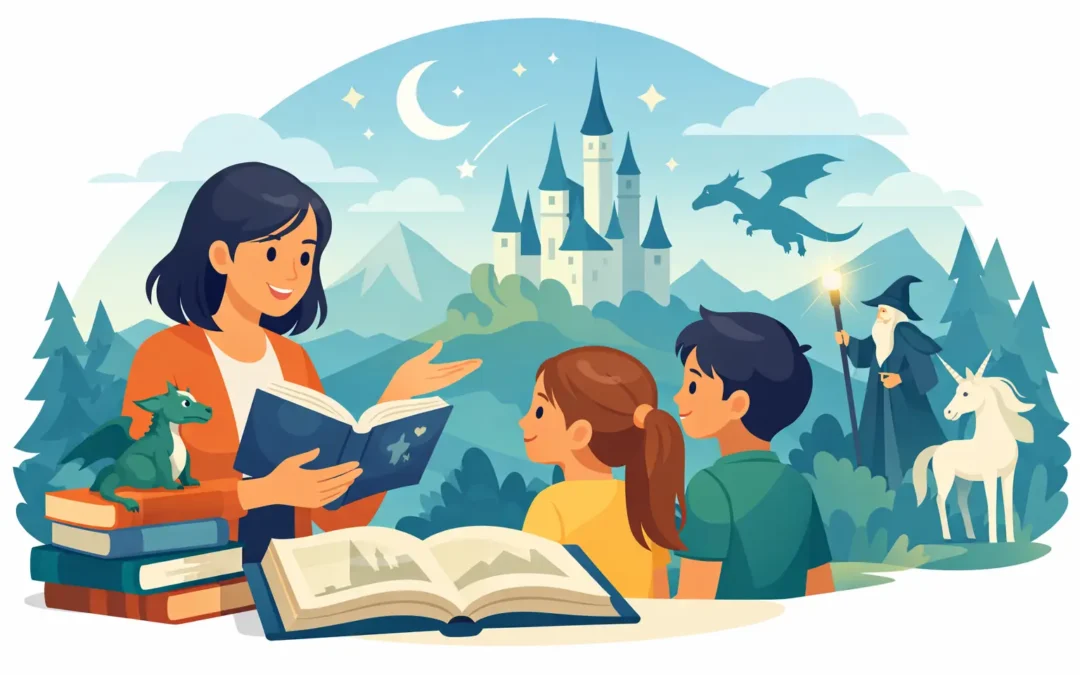
A child stands in front of a library shelf, drawn to the dragon on one cover and the glowing castle on another. The question is not simply which book looks exciting. Knowing how to recommend fantasy books means helping that child find a story that feels like an invitation: into adventure, yes, but also into courage, friendship, and the comforting knowledge that they are not alone.
For middle grade readers, the right fantasy book can make reading feel personal. Magic may be the doorway, but the feelings behind it are often what stay with them. A child who worries about fitting in may connect with a lonely apprentice. A reader facing change at home may find strength in a character rebuilding a world. The best recommendations honor both the reader’s imagination and their real life.
Start With the Reader, Not the Shelf
Before naming a title, get curious about what the young reader already loves. Ask about favorite movies, games, stories, or even the kind of day they have had. A child who says they want “something with magic” may be looking for a funny adventure, a spooky mystery, a school story, a quest, or a tale with a quiet magical secret.
A few gentle questions can reveal much more than age alone. Do they enjoy fast-paced action, or would they rather spend time getting to know the characters? Are they hoping for a laugh, a shiver, or a story that feels cozy? Do they want a hero who is brave from the start, or one who has to discover their courage?
Adults do not need to turn this into an interview. A simple conversation is enough. “What was the last book you could not stop reading?” often opens the door. If the answer is a familiar series, ask what made it work: the humor, the magical rules, the friendships, or the danger.
How to Recommend Fantasy Books by Feeling
Fantasy comes in many moods. Matching a book’s emotional atmosphere to a reader matters just as much as matching its reading level.
Some children want wonder without too much worry. They may enjoy enchanted libraries, magical pets, hidden doorways, clever puzzles, and friendships that grow stronger through small acts of bravery. These stories can offer a safe place to practice courage.
Other readers are ready for higher stakes. They may want dangerous quests, ancient prophecies, monsters, betrayals, or a hero who must make a difficult choice. Those books can be thrilling, but it helps to be honest about their intensity. A recommendation is more thoughtful when it includes a little context: “This one has a scary villain, but the main character has loyal friends,” or “There is sadness in this story, though it ends with hope.”
That balance is especially useful when a fantasy story touches grounded challenges such as money troubles, family conflict, grief, or feeling left out. Young readers often recognize those feelings immediately, even when the setting includes spells and talking animals. A book can be meaningful without being the right fit for every child at every moment. Readiness matters.
Look Beyond Reading Level
A book’s reading level is useful, but it cannot tell the whole story. A strong reader may still prefer gentle emotional stakes, while a child who reads more slowly may be ready for big ideas presented in accessible language. Fantasy is full of invented words, unusual settings, and layered plots, so confidence can matter as much as vocabulary.
When you recommend a book, consider its length, chapter structure, and the amount of world-building required. A reader new to fantasy may feel more comfortable with a story set partly in the everyday world, where one magical element changes everything. Another child may be eager to enter a completely new kingdom with maps, mythical creatures, and a long list of characters.
It is also helpful to avoid treating a challenging book as a prize and an easier book as a step backward. The goal is not to prove that a child can finish the biggest book on the shelf. The goal is to help them want to read another one.
Give a Tiny, Spoiler-Free Spark
A recommendation should create curiosity, not explain the whole plot. Share the premise, name the feeling, and leave room for discovery.
Instead of saying, “It is about a girl who finds a magical book,” try, “This is about a girl who discovers that books can hold more than stories, and she has to decide what kind of magic she wants to use.” The second version gives the reader a question to carry into the first chapter.
For a child who loves stories about books, libraries, and the power of words, K.L. Baxton’s The Book Witch can be a natural choice. Its magic is connected to the world of books, while its heart lies in friendship, resilience, and learning to see worth in yourself when life feels uncertain.
Keep your description honest. If a story opens slowly, say that the world becomes richer as the reader settles in. If it has a bittersweet moment, acknowledge it. Children deserve recommendations that respect their feelings, and parents, teachers, and librarians deserve enough information to make a confident choice.
Offer Choice Instead of a Test
A recommendation can feel like pressure when it sounds like an assignment. This is particularly true for children who have been told they are “not readers” or who have struggled to find a book that holds their attention.
Offer two or three options with different kinds of magic. You might place a humorous magical school story beside a tender fantasy about family and a suspenseful quest. Then describe each in a sentence or two. “This one is funny and full of mishaps. This one has a secretive, cozy feeling. This one moves quickly and has more danger.”
Choice gives young readers ownership. It also teaches them that fantasy is not one narrow category. There is room for dragon riders and book witches, mischievous ghosts and brave siblings, faraway kingdoms and magic hidden in a neighborhood just like theirs.
If a child tries a book and does not connect with it, let them stop without guilt. A book abandoned at page thirty is not a failure. It is useful information. Perhaps the pacing was too slow, the characters felt too old, or the story was simply not what they needed that week. Ask what they did and did not enjoy, then use that answer for the next recommendation.
Help Young Readers Notice What They Love
Once a child finishes a fantasy book, the conversation should not end with “Did you like it?” That question can be hard to answer. Try asking which character they would want as a friend, what magical object they would keep, or whether they would have made the same choice as the hero.
These questions make space for children to talk about character, fairness, fear, and belonging without feeling as though they are being taught a lesson. They also help adults recommend the next book with greater care. A reader who loved the loyal sidekick may want another friendship-centered story. One who loved solving clues may be ready for a magical mystery.
Teachers and librarians can extend this approach through book talks, displays built around feelings rather than only genres, and read-aloud excerpts that show a book’s voice. Parents can leave a new book where a child is likely to find it, then let curiosity do some of the work. The most memorable recommendation is often the one that feels discovered.
Make Room for Hope
Fantasy gives children a place to meet fear in a world where courage can be practiced. It can show that ordinary people have gifts they do not yet recognize, that friendships can survive hard seasons, and that even a small choice can change what happens next.
When you recommend a fantasy book, you are not only handing over a story about magic. You are saying, “There may be a place in these pages for what you wonder about, what you worry about, and what you hope is possible.” Let that be the compass. The right book does not have to be the loudest or most popular one. It only has to open a door the child is ready to walk through.